Fast Non-Local Algorithm for Image Denoising pdf
Jin Wang, Yanwen Guo, Yiting Ying, Yanli Liu, Qunsheng Peng
IEEE International Conference on Image Processing 2006 (ICIP 2006), Atlanta,
USA. pp. 1429-1432. (EI)
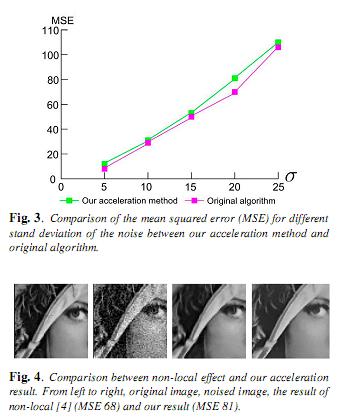
For the non-local denoising approach presented by Buades et al., remarkable denoising results are obtained at high expense of computational cost. In this paper, a new algorithm that reduces the computational cost for calculating the similarity of neighborhood windows is proposed. We first introduce an approximate measure about the similarity of neighborhood windows, then we use an efficient summed square image (SSI) scheme and fast Fourier transform (FFT) to accelerate the calculation of this measure. Our algorithm is about fifty times faster than the original non-local algorithm both theoretically and experimentally, yet produces comparable results in terms of mean-squared error (MSE) and perceptual image quality
|
Synthesizing Variational Direction and Scale Texture on Planar Region pdf
Yanwen Guo, Xiaodong Xu, Jin Wang, Yiting Ying, Qunsheng Ying
2006 Pacific-Rim Conference on Multimedia (PCM
2006), Also in Springer Lecture Notes in Computer Science, LNCS 4261, 2006, pp. 159-166. (SCI)
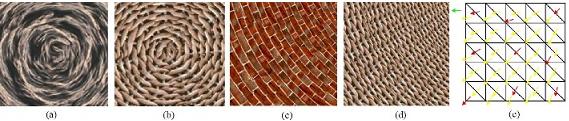
Traditional 2D texture synthesis methods mainly focus on seamlessly generating a big size texture, with coherent texture direction and homogeneous texture scale, from an input sample. This paper presents a method of synthesizing texture with variational direction and scale on arbitrary planar region. The user first decomposes the interest region into a set of triangles, on which a vector field is subsequently specified for controlling the direction and scale of the synthesized texture. The variational texture direction and scale are achieved by mapping a suitable texture patch found in the sample via matching a check-mask, which is rotated and zoomed according to the vector field in advance. To account for the texture discontinuity induced by not well matching or different texture directions/scales between adjacent triangles, a feature based boundary optimization technique is further developed. Experimental results show the satisfactory synthesis results.
|
Automatic Foreground Extraction of Head Shoulder Images pdf
Yanwen Guo, Hanqiu Sun, Qunsheng Peng, Gangshan Wu
Computer Graphics International 2006 (CGI 2006), Springer Lecture Notes in
Computer Science, LNCS 4035, 2006, pp. 385-396. (SCI)
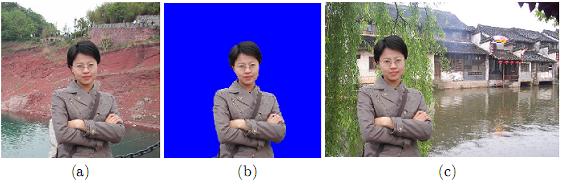
Most existing techniques of foreground extracting work only in interactive mode. This paper introduces a novel algorithm of automatic foreground extraction for special object, and verifies its effectiveness with head shoulder images. The main contribution of our idea is to make the most use of the prior knowledge to constrain the processing of foreground extraction. For human head shoulder images, we first detect face and a few facial features, which helps to estimate an approximate mask covering the interesting region. The algorithm then extracts the hard edge of foreground from the specified area using an iterative graph cut method incorporated with an improved Gaussian Mixture Model. To generate accurate soft edges, a Bayes matting is applied. The whole process is fully automatic. Experimental results demonstrate that our algorithm is both robust and efficient.
|
Example Based Painting Generation pdf
Yanwen Guo, Jinhui Yu, Xiaodong Xu, Jin Wang, Qunsheng Peng
Computer Graphics International 2006 (CGI 2006), Also in Journal of Zhejiang
University Science, 2006, 7(7), pp. 1152-1159. (EI)
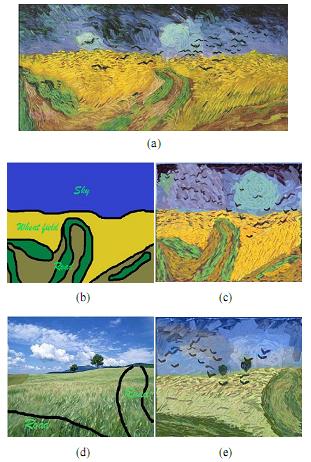
We present an approach for generating paintings on photographic images with the style encoded by the example paintings and adopt representative brushes extracted from the example paintings as the painting primitives. Our system first divides the given photographic image into several regions on which we synthesize a grounding layer with texture patches extracted from the example paintings. Then, we paint those regions using brushes stochastically chosen from the brush library, with further brush color and shape perturbations. The brush direction is determined by a direction field either constructed by a convenient user interactive manner or synthesized from the examples. Our approach offers flexible and intuitive user control over the painting process and style.
|
基于大位移视点图像的单帧图像修复技�?pdf
刘春�? 潘梁, 郭延�?, 王进, 彭群�?/span>
软件学报, 17:138-147.) (EI)
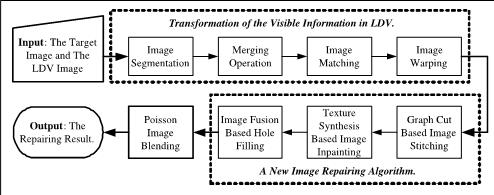
提出一种基于大位移视点图像的单帧图像修复算�?利用大位移视点图像中的可见信息修补目标图像中的被遮挡或信息丢失区�?算法的关键在于如何转化大位移视点图像的可见信息为可用信息,以及如何利用得到的可用信息来有效地修补目标图�?在交互指定待修复的目标区域后,算法首先将所有图像分割为不同的平面场景区�?并基于图像匹配将大位移视点图像中的平面场景区域变换到当前视点.因此,其中的可见信息就可被直接使用.进而通过定义合适的修复和融合优先级函数,提出基于纹理合成和图像融合的图像修复算法,利用获得的可用信息来修补目标区域.修复区域和目标图像之间的鬼影现象使用Poisson图像融合算法来消�?以达到无缝的修复结果.实验结果表明,该算法能够修复较大的丢失信息区域中的结构和纹理信�?具有一定的实用价�?
|
Video Based Human Motion Synthesis pdf
Yanwen Guo, Jin Wang, Feng Tang, Xiufen Cui, Qunsheng Peng
Journal of Image and Graphics, 2006, 11: pp. 166-172
为了快速地进行逼真的人体运动合�?提出一套合成人体运动的全新思路,新算�?该新算法首先依据人体关节链结构将人体分解为若干单�?然后基于人体运动的视频序列对每个单元进行视频采样,并在其动作空间建立容量样本库;最后通过从样�?
库中抽取给定动作瞬间人体单元的视频采样,就可以生成新的任意动作序列。由于该算法是基于各单元骨架信息对人体动作进行编辑,并能对各个单元视频图像进行符合人体动作生理的光滑拼接,因此能较好地实现着装的人体运动效果。实验表明,该方法的绘制结果逼真,编辑人体新姿态、新动作快捷、方便。论文思想有着一定的学术价值,可以尝试于其他对象的运动合成.
|
纹理映射_合成与替换算法研�? pdf
Yanwen Guo
浙江大学 博士论文
纹理指包含一定重复模式又呈现一定随机性的事件,它可以描述自然界中非常广阔的自然现象,例如:声音、图像、视频、运动及几何曲面等等。图形学中的纹理主要指位图图像。采用纹理可以有效表现景物表面的细节特征,增强绘制的真实感。由于纹理技术在影视娱乐、工业设计和虚拟仿真等方面的广泛应用,关于纹理的研究一直是计算机图形学、计算机视觉以及图像处理领域的研究热点�?本文围绕当前纹理研究中的若干热点问题:约束纹理映射、三维纹理合成、图像和视频的纹理替换及纹理技术在非真实感绘制中的应用等方面展开研究�?(1)约束纹理映射。纹理映射一般指将二维纹理映射到三维景物表面的过程。可以有效地表现景物表面的纹理细节,提高景物绘制的真实感。本文提出一种基于调和映射的约束纹理映射方法,利用调和映射建立纹理平面和参数化后网格模型的对应关系,给出约束纹理映射问题的一个解析解。由于调和映射具有保持映射能量最小的性质,该方法可以最小化约束纹理映射可能导致的扭曲形变。同时我们还提出一种对映射效果实时优化的算法,有效减少了约束纹理映射的后期交互�?纹理映射的有效性是约束纹理映射的一个关键问题。本文提出一种基于分块映射的方法,把纹理图像和网格模型按照特征点进行有效剖分并建立对应关系,实现对应的映射,保持了纹理映射这个特殊参数化问题的有效性。由于该方法不需要对网格模型预先参数化,从而提高了纹理映射的效率。同样的思想应用于网格模型的形状过渡也取得了良好的效果�?(2)三维纹理合成。纹理合成指由一张给定小样本纹理生成大区域纹理的过程。本文提出一种在复杂网格模型表面生成纹理的算法。该算首先建立网格模型的基网格表示,在基网格上合成纹理,然后把合成效果映射回原始网格;在网格模型上建立的基网格可以应用于不同纹理的合成。本文还提出一种对三角形网格的附加纹理图像压缩存储的方法,节约了纹理内存。通过对纹理图像上任意点的邻域预处理编码的方法,进一步提高了合成效率�?(3)图像和视频的纹理替换。纹理替换指在图像/视频的目标区域采用新的纹理替换原有纹理,在未知原始几何和光源信息的情况下,使替换后目标区域保持原纹理依附在表面上产生的自然变形和光照效果。纹理替换在虚拟展示、影视娱乐等方面有巨大的应用前景。本文通过求解Possion方程保持替换后纹理的依附变形,通过把RGB颜色空间转换到YCbCr颜色空间以及传递Y颜色分量,保持了原纹理的光照效果�?
|
| |
| |
|
|

 Publications