Ensemble of trusted firmware services based on TPM. pdf
ZhenLong Du, XiaoLi Li, Yanwen Guo*, Kangkang Shen
In International Journal of Digital Content Technology and its Applications , 2011.
How to build trusted firmware platform has been a research hot in computer security community. In this paper, a novel entrusted firmware services under UEFI framework are proposed, which exploits the high safety of Trusted Platform Module (TPM) root and uneditability of firmware for building the trusted platform in code modification checking, user identity authenticating, hard disk attestation and real time security alert. The experiment showed that the presented schemas are feasible, and could efficiently construct a trusted firmware platform.
|
Content sensitive collection snapping pdf
Yanwei Fu, Yanwen Guo*
IEEE ICME 2011
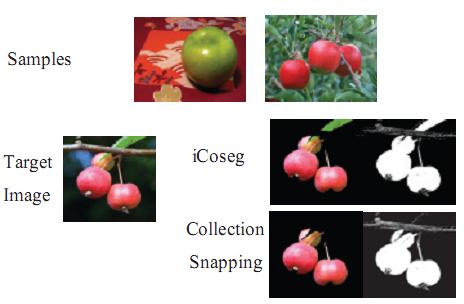
Interactive segmentation methods have greatly simplified the task of object cutout from an image. However, segmenting a large number of images in a collection is still a tedious task. In this paper, we present a content-sensitive group segmentation method that iteratively segments the images in a collection and incrementally refines the results. With our method, a user only provides a small number of strokes to segment and refine a few sample images. For each of the rest of images, our method finds relevant sample images and applies the corresponding appearance models to guide the segmentation. To improve the segmentation results using the user strokes on a few images with unsatisfactory segmentation results, our method calculates the relevance map that measures the probability that a stroke can be appropriately applied at each pixel/region of an image, and applies it accordingly. Our experiments show that our method can effectively segment an image collection with a wide variety of image content and significantly reduce user input.
|
Multi-keyframe abstraction from videos pdf
Ping Li, Yanwen Guo*, Hanqiu Sun
IEEE ICIP 2011
This paper presents a method for abstracting multi-keyframe from video datasets. Existing video abstraction methods focused on simple view videos, and the results will be unacceptable if applied to overlapping views directly due to limitations like unavoidable redundancy and complicated inner correlations. We propose a correlation map to naturally model the correlations with various attributes among multi-keyframe, keyframe importance and weighted correlations are then computed to construct the map. The weighted correlations, unlike the unweighted ones, not only model probabilistic relationship among keyframes but also address the temporal and visual similarity. We facilitate the abstraction process via SVM classification and keyframes reduction using rough set. The multi-keyframe correlation map, which serially assembles event-centered keyframes in temporal order, is presented for displaying the abstraction, which shows the correlations and improves the browsability of video datasets.
|
|
|
Exploiting feature,correspondence constraints for image recognitionpdf
Linbo Wang, Feng Tang, Yanwen Guo*, SukHwan Lim, Nelson L.Chang
IEEE ICIP 2011
Image recognition is one of the fundamental problems in multimedia analysis. Typically in the training database, there will be more than one image for each object, however most existing bag-of-features based approaches treat them independently and completely ignore the feature correspondence relationship among them. As a result, features corresponding to the same physical point may be clustered into different clusters, which finally leads to inaccurate image representations for recognition. To tackle the problem, we present a supervised codebook construction algorithm exploiting the feature correspondence constraints in feature clustering. Features in different images of the same object are first matched, then ho-mography between images are computed to remove outliers as well as recover the feature correspondences that are not correctly matched. Features belonging to the same physical point are enforced to be in the same cluster. We show via experiments that codebook constructed using this approach can improve the recognition performance.
|
| |
Color-mood-aware clothing re-texturing pdf
Jianbing Shen, Hanqiu Sun, Xiaoyang Mao, Yanwen Guo, Xiaogang Jin
CAD/Graphics 2011
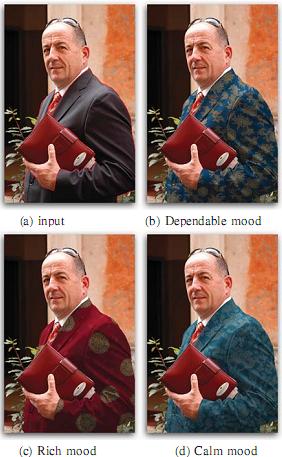
In this paper, we present a novel color-mood-aware technique to re-texture clothing in a photograph. An efficient classification algorithm is developed to classify clothing textures using color mood scheme. To re-texture the clothing, our approach first computes the gradient maps for the cloth region to be replaced and then calculates the texture distortion coordinates on the projected cloth region according to the gradient maps. After the user selects a target clothing texture from the classified clothing texture database, the lighting and shading effects on the original photograph is transferred using the HSV color space. Experimental results show that the proposed approach successfully re-textures the clothes in photographs while preserving the geometry and lighting features.
|
| |
骨架引导的网格模型圆柱面参数�?pdf
郭潇�? 郭延�?, 郭凯, 王文�?/span>
第八届中国计算机图形学大会,计算机辅助设计与图形学学�?/strong>
Image recognition is one of the fundamental problems in multimedia analysis. Typically in the training database, there will be more than one image for each object, however most existing bag-of-features based approaches treat them independently and completely ignore the feature correspondence relationship among them. As a result, features corresponding to the same physical point may be clustered into different clusters, which finally leads to inaccurate image representations for recognition. To tackle the problem, we present a supervised codebook construction algorithm exploiting the feature correspondence constraints in feature clustering. Features in different images of the same object are first matched, then ho-mography between images are computed to remove outliers as well as recover the feature correspondences that are not correctly matched. Features belonging to the same physical point are enforced to be in the same cluster. We show via experiments that codebook constructed using this approach can improve the recognition performance.
|
| |
|
|

 Publications