Multi-view Video Summarization
pdf
Yanwei Fu, Yanwen Guo*, Yanshu Zhu, Feng Liu, Chuanming Song
and Zhi-Hua Zhou
IEEE Trans. on Multimedia 2010,12(7), Regular Paper (IEEE TMM,
SCI, EI, Corresponding Author)
Previous
video summarization studies focused on monocular videos, and the results would
not be good if they were applied to multi-view videos directly, due to problems
such as the redundancy in multiple views. In this paper, we present a method for
summarizing multi-view videos. We construct a spatio-temporal shot graph and
formulate the summarization problem as a graph labeling task. The
spatio-temporal shot graph is derived from a hypergraph, which encodes the
correlations with different attributes among multi-view video shots in
hyperedges. We then partition the shot graph and identify clusters of
event-centered shots with similar contents via random walks. The summarization
result is generated through solving a multi-objective optimization problem based
on shot importance evaluated using a Gaussian entropy fusion scheme. Different
summarization objectives, such as minimum summary length and maximum information
coverage, can be accomplished in the framework. Moreover, multi-level
summarization can be achieved easily by configuring the optimization parameters.
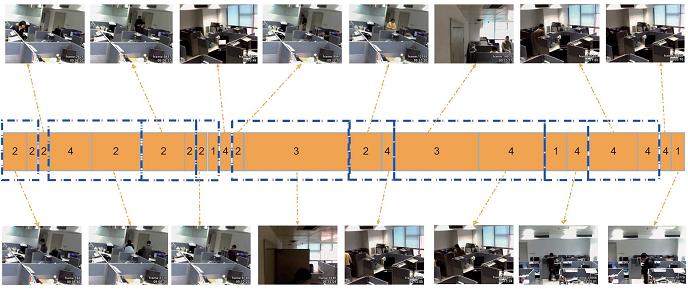
We also propose the multi-view storyboard and event board for presenting
multi-view summaries. The storyboard naturally reflects correlations among
multi-view summarized shots that describe the same important event. The
event-board serially assembles event-centered multi-view shots in temporal
order. Single video summary which facilitates quick browsing of the summarized
multi-view video can be easily generated based on the event board
representation.

 Publications