Learning-Based 3D Face Detection Using Geometric Context pdf
Yanwen Guo, Fuyan Zhang, Chunxiao Liu, Hanqiu Sun, Qunsheng Peng
Computer Animation and Virtual Worlds, 2007, 18(5): 483-
492. (CAVW, SCI, EI)
In computer graphics community, face model is one of the most useful entities. The automatic detection of 3D face model has special significance to computer graphics, vision, and human-computer interaction. However, few methods have been dedicated to this task. This paper proposes a machine learning approach for fully automatic 3D face detection. To exploit the facial features, we introduce geometric context, a novel shape descriptor which can compactly encode the distribution of local geometry and can be evaluated efficiently by using a new volume encoding form, named integral volume. Geometric contexts over 3D face offer the rich and discriminative representation of facial shapes and hence are quite suitable to classification. We adopt an AdaBoost learning algorithm to select the most effective geometric context-based classifiers and to combine them into a strong classifier. Given an arbitrary 3D model, our method first identifies the symmetric parts as candidates with a new reflective symmetry detection algorithm. Then uses the learned classifier to judge whether the face part exists. Experiments are performed on a large set of 3D face and non-face models and the results demonstrate high performance of our method
|
Image Completion based on Views of Large Displacement pdf
Chunxiao Liu, Yanwen Guo, Liang Pan, Qunsheng Peng, Fuyan Zhang
The Visual Computer, 2007, 23(10): 833-841. (TVC, SCI, EI)
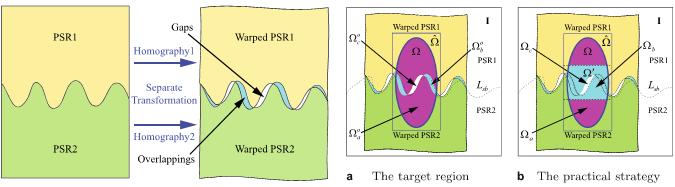
This paper presents an algorithm for image completion based on the views of large displacement. A distinct from most existing image completion methods, which exploit only the target image’s own information to complete the damaged regions, our algorithm makes full use of a large displacement view (LDV) of the same scene, which introduces enough information to resolve the original ill-posed problem. To eliminate any perspective distortion during the warping of the LDV image, we first decompose the target image and the LDV one into several corresponding planar scene regions (PSRs) and transform the candidate PSRs on the LDV image onto their correspondences on the target image. Then using the transformed PSRs, we develop a new image repairing algorithm, coupled with graph cut based image stitching, texture synthesis based image inpainting, and image fusion based hole filling, to complete the missing regions seamlessly. Finally, the ghost effect between the repaired region and its surroundings is eliminated by Poisson image blending. Our algorithm effectively preserves the structure information on the missing area of the target image and produces a repaired result comparable to its original appearance. Experiments show the effectiveness of our method.
|
基于网格优化的图像纹理替换方法 pdf
郭延文, 孙汉秋, 彭群生, 武港山
计算机学报, 2007, 30(9):1580-1587
Yanwen Guo, Hanqiu Sun, Qunsheng Peng, and Gangshan Wu, Mesh Optimization Based Image Texture Replacement, Chinese Journal of Computers, 2007, 30(9): 1580-1587)
This paper presents a novel approach for replacing textures of specified regions in the input image and video using stretch-based mesh optimization. The retexturing results have the similar distortion and shading effect conforming to the unknown underlying geometry and lighting conditions. For replacing textures in a single image, two important steps are developed: The stretch-based mesh parameterization incorporating the recovered normal information is deduced to imitate perspective distortion of the region of interest; the Poisson-based refinement process is exploited to account for texture distortion at fine scale. The luminance of the input image is preserved through color transfer in YCbCr color space. Our approach is independent of the replaced textures. Once the input image is processed, any new textures can be applied to efficiently generate the retexturing results. For video retexturing, we propose key-frame-based texture replacement extended and generalized from the image retexturing. Our approach repeatedly propagates the replacement results of key frames to the rest of the frames. We develop the local motion optimization scheme to deal with the inaccuracies and errors of robust optical flow when tracking moving objects. Visibility shifting and texture drifting are effectively alleviated using graphcut segmentation algorithm and the global optimization to smooth trajectories of the tracked points over temporal domain. Our experimental results showed that the proposed approach can generate visually pleasing results for retextured images and video.
|
| |
| |
|
|

 Publications